Posted on

The Rise of FroYo and the Decline of Ice Cream

Check out this video and article on Yahoo! Finance about the decline of ice cream and the rise of frozen yogurt.

http://finance.yahoo.com/blogs/daily-ticker/decline-american-treat-140930869.html

Here are a few highlights:

  • The number of frozen yogurt shops increased by 24% between 2011 to 2012, while the number of ice cream shops declined.
  • Ice cream sales are on track to hit their lowest levels since the mid 1990s.
  • Consumers are leaving ice cream because of health reasons and because it hasn’t kept up with the more innovate and fun vibe of frozen yogurt.


Posted on

How to Get the Most out of Your Machines

Frozen yogurt machines have two main jobs: 1) freeze the frozen yogurt mix, and 2) whip air into the mix. There are a few settings and components you should be familiar with on your machine to get the best performance and to make the best frozen yogurt.

Air

Air is the secret ingredient to making frozen yogurt come out smooth and creamy. If your product is coming our icy, dense, and dark in color then it doesn’t have enough air in it. Look at our blog article or our instructional video on how to get set the air.

Temperature

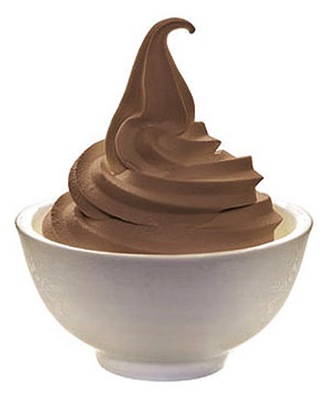
If your frozen yogurt comes out wet or soft, it’s because the temperature settings on your machine are not cold enough. Frozen yogurt should come out firm and stiff with no visible “wetness”. A good test of the right consistency is if you can make a curl at the peak of the yogurt swirl. If the machine is too cold the product in the hopper can freeze and the product in the freezing cylinder won’t come out (which can damage your machine).

The ideal temperature for the hopper is 36-40 degrees Fahrenheit or 2-4 degrees Celsius and the ideal temperature for the frozen yogurt as it is dispensed is 16-17 degrees Fahrenheit or about negative 8 degrees Celsius.

Parts

One of the main causes for icy frozen yogurt is worn out scraper blades. Although each frozen yogurt machine is slightly different, they all have a beater that scrapes the inside of the freezing cylinder. This makes sure no frozen ice particles build up on the edges. If the scraper blades are worn down they can’t adequately scrape the inside of the freezing barrel, making the frozen yogurt icier than it should be. The scraper blades on most machines can be pretty easily replaced and they should be switched out every month or so depending on the usage of your machine. O-rings are another part that wears out and should be replaced according the machine manufactures recommendations.

Posted on

Frozen Yogurt Toppings

Toppings are a critical part of frozen yogurt shop operations. They play a big role in customer satisfaction, but if not managed closely you an actually lose money on your toppings. You should try to be below 30 cents per ounce on your average toppings cost. If you can get down towards 23-25 cents per ounce you are doing great.

Be careful of expensive toppings that are very light, like whipped cream. Here are a couple of tricks to manage the more expensive toppings.:

  1. Put the most expensive toppings the farthest away from the last soft-serve machine so customers fill their cup on the less expensive toppings.
  2. Put the most expensive toppings at the back of the toppings bar so they are a little harder to reach.
  3. Use smaller serving spoons for the more expensive toppings.

Also, with fresh toppings, such as fruits, you should rotate the toppings to ensure that you always have fresh product in the toppings bar.

Here are suggested list of toppings. You can find recommendations for toppings supplies on our Equipment & Supplies page.

Dry Toppings

  • almonds
  • butterfinger
  • cap’n crunch
  • carob chips
  • cocoa pebbles
  • coconut flakes
  • fruity pebbles
  • graham cracker crumbs
  • gummi bears
  • heath toffee
  • jelly bellies
  • kit kat
  • m&m’s
  • peanut m&m’s
  • mini caramel cups
  • chocolate chips
  • mini peanut butter cups
  • nestlé crunch
  • non-fat granola
  • old fashioned granola
  • oreo cookies
  • peanuts
  • pecans
  • peanut butter chips
  • reese’s peanut butter cups
  • snow caps
  • chocolate sprinkles
  • rainbow sprinkles
  • thin mint cookies
  • twix
  • walnuts
  • yogurt chips

Fresh Toppings

  • strawberries
  • raspberries
  • blackberries
  • blueberries
  • peaches
  • mangos
  • kiwi
  • pineapple
  • bananas
  • cinnamon apples
  • mochi
  • cookie dough
  • fudge brownies
  • fat-free brownies
  • cheesecake bits

Hot Toppings

  • hot fudge
  • caramel sauce
  • non fat / no sugar-added fudge

Nuts_Full_header

Posted on

The Secret Ingredient for Amazing Frozen Yogurt

Close your office door and make sure no one is listening because I’m about to share with you the secret to making amazing frozen yogurt…ready…here it is…AIR. That’s right – one of the key components of smooth and creamy frozen yogurt is to have air or overrun in the product. If the product comes out icy and dense that means there isn’t enough air in the mix. This is especially important with natural frozen yogurt mixes.

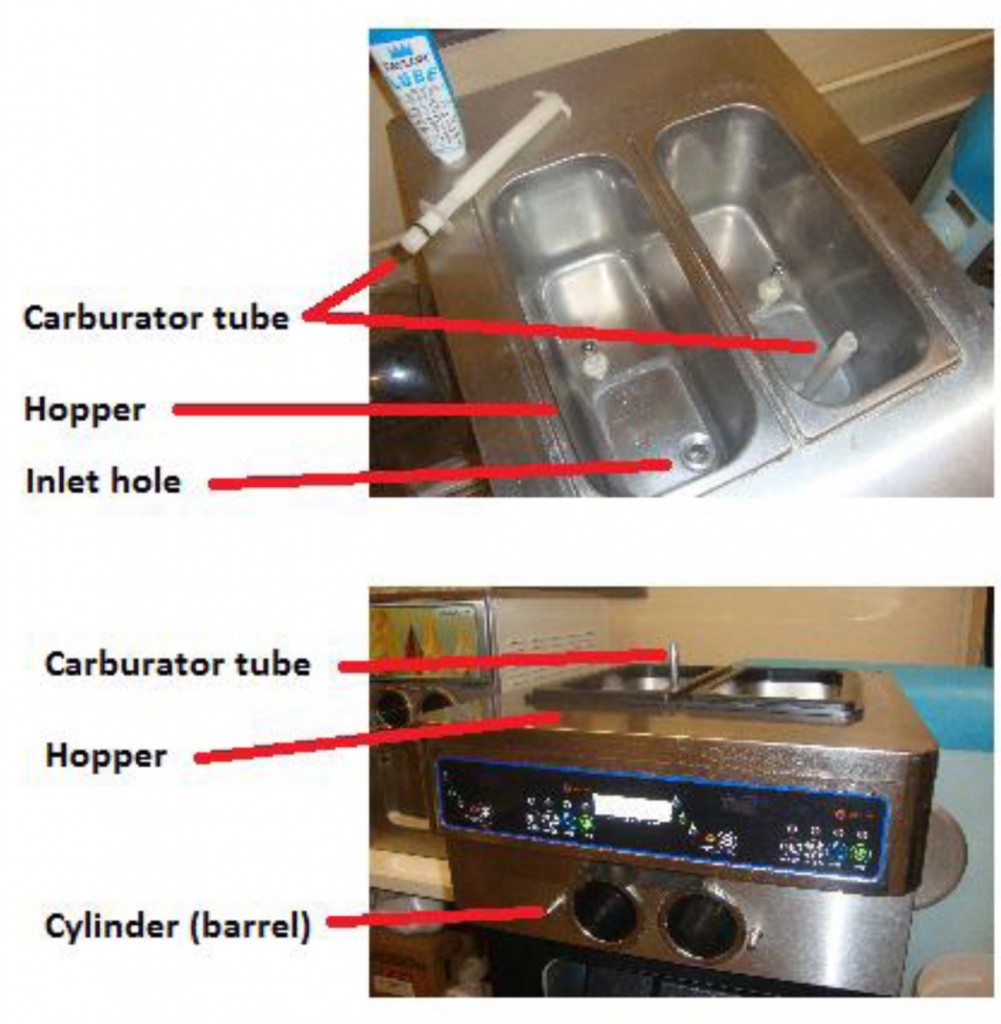
All frozen yogurt machines have a hopper and freezing cylinder. The hopper is where you pour the mix, and the freezing cylinder is the horizontal empty cylinder behind the handles where the mix is frozen and the air is whipped into it. Inside the freezing cylinder there should be at least 30-40% air. This gives room for the product to expand and create a nice, creamy consistency.

Getting air into the product will depend on the type of soft-serve machine you have. Here is a quick breakdown. For more detailed instructions and help contact us at 1-800-788-0808 or info@nancis.com. You can also visit our Training Page for a howto video on adding air into the product.

Pressurized or Pump Soft-Serve Machine

These machines pump the product into the freezing cylinder with the exact amount of air you want – up to 100% air. Pump machines allow for you to set the precise amount of air. Consult the operators manual for your machine to find out how to adjust these settings.

Gravity Soft-Serve Machines

With gravity machines, the mix is poured into a hopper on the top of the machine and gravity pulls the mix into the freezing cylinder. On a gravity machines you need to manually set the air, for a maximum of 45% air.

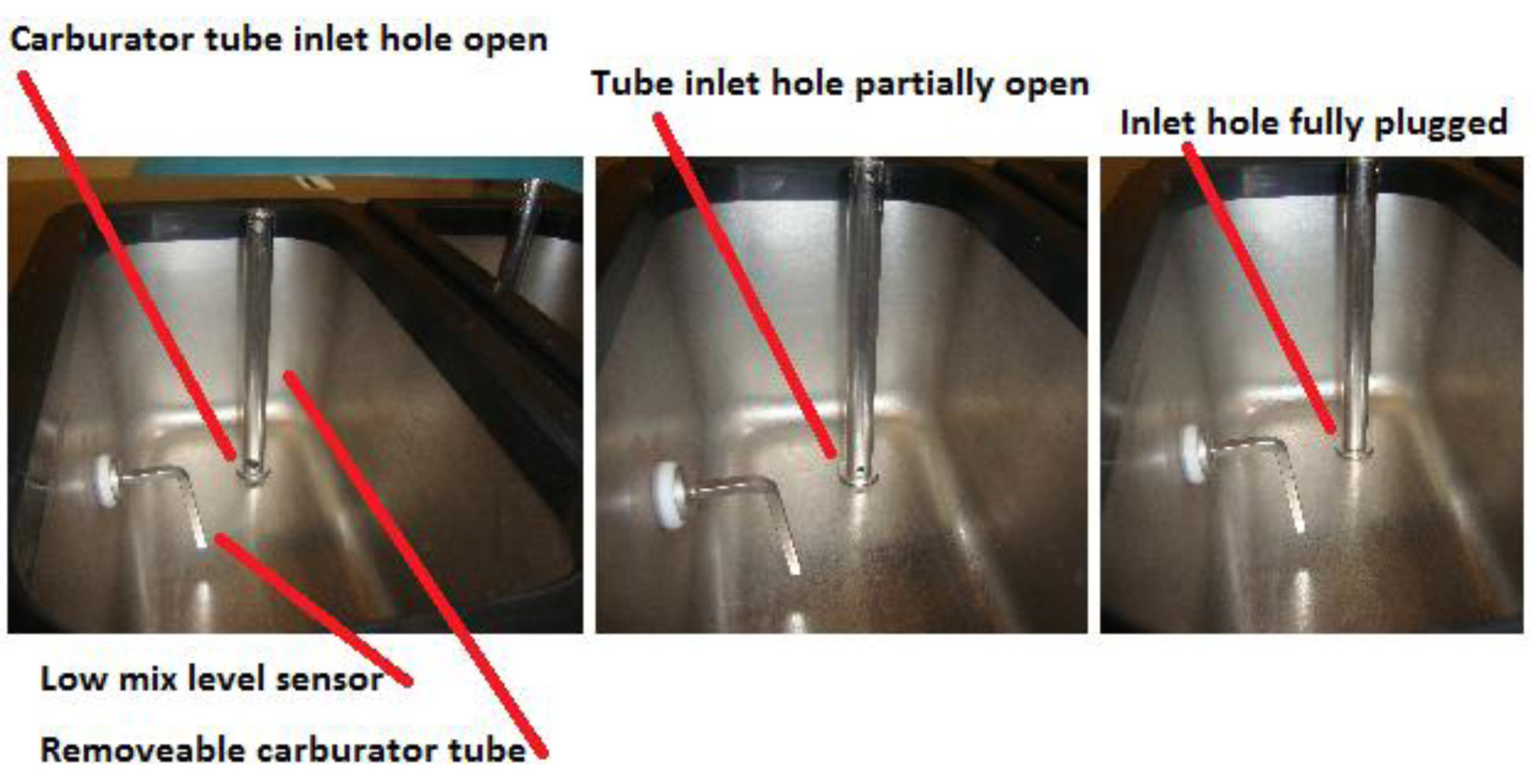
One very important piece on the machine is the carburetor tube or air tube. The carburetor tube is a skinny tube – usually stainless steel – that you insert into the intake hole in the bottom of the hopper. Once inserted, the top of the tube sticks up out of the product allowing air to get down into the product. All carburetor tubes have some way to shut off the product intake – either by flipping the tube over or by closing off the intake hole using a sleeve that fits around the tube.

Here are the 6 steps:

  1. Pour the frozen yogurt mix into the hopper without the carburetor tube and wait for the bubbling from the intake hole to stop. The freezing cylinder is now full.
  2. Insert the carburetor tube to stop the product from flowing into the freezing cylinder.
  3. Turn on the soft-serve machine and wait for it to freeze down and shut off.
  4. Keeping the intake closed, dispense 8-10 ounces of frozen yogurt into a clean cup. This product can be put back into the hopper.
  5. Wait for the machine to cycle off then open the air intake either by flipping the tube around or sliding the sleeve on the tube.
  6. The overrun is now set and the product should come out smooth and creamy. As long as you leave the air tube in place it will stay this way.
Another important factor in dispensing a great product is the temperature on the frozen yogurt coming out of the machine. Nanci’s mixes are best served at 17 degrees F.

If you have any questions, please contact us.


Posted on

Diary of a Diabetic: the Power of Stevia

We received some great feedback about our Stevia Frozen Yogurt Mix from a type 2 diabetic named Steve (this is a real experience but names have been changed to protect the innocent). Keep in mind that this is not a conclusive scientific study, but rather one person’s anecdotal account.

On two different days, Steve measured his blood sugar level before eating frozen yogurt and two hours after. He compared YoCream, which is sweetened with lots of sugar, and Nanci’s stevia-sweetened frozen yogurt. Keep in mind that Steve does not take any medications to control his blood sugar levels.

Here are his results:

Day 1: YoCream sucrose (table sugar) sweetened frozen yogurt
Starting blood sugar level: 135
Blood sugar level 2 hours after eating 4 oz. of YoCream: 280

Day 2: Nanci’s Stevia Frozen Yogurt
Starting blood sugar level: 123
Blood sugar level 2 hours after eating 4 oz. of Nanci’s: 116

These numbers mean that the Nanci’s Stevia Frozen Yogurt had no affect on Steve’s blood sugar level, while the YoCream product caused his blood sugar to spike dramatically.

For many people with diabetes who can’t handle sugar, stevia is an excellent option. It is an herb from South America that has been used as a natural sweetener for centuries. The leaves of the Stevia plant have a clean refreshing taste and have zero calories, zero glycemic index, and zero carbs. And it’s 300 times sweeter than sugar, so you can use very little of it. And best of all, it is natural!

Check out our Vanilla Stevia Frozen Yogurt mix on our website. We also have a Chocolate Stevia Frozen Yogurt mix coming soon.

Posted on

Improving Your Customer Service

Customer Service is the root of many businesses, particularly the Frozen Yogurt industry. For most people, going out to grab a cup of froyo isn’t just about the smooth and creamy treat melting on your tongue and tickling your taste buds.  It’s about the experience.  Customer Service is not a transaction — it is the relationship with your customer. It’s making that frozen desert into a little cup of personal bliss for each customer.

Important basics to remember

-SMILE! Even the friendliest person in the world might come across as indifferent or fake if that is what their face says. Remember, the amount of communication between two people is predominantly non-verbal.

-BE ATTENTIVE.  No one likes to be ignored. Greet customers as they enter, and bid them farewell as they leave. On occasion your shop might be very busy — perhaps a line out the door and around the corner (good for you!) — but remember to keep checking in with the customers as they come in and as they wait. It does not matter if they are at the front of the line or just stepping into the back, their business matters.

-BE PROFESSIONAL. Hop off the counters, and wash your hands often. Quit touching your face and looking at your feet. Be confident in how you carry yourself in the workplace and show respect even when disrespected (hey it happens). Keep composed and be ready to work!

-MAKE SUGGESTIONS, GET CREATIVE. Most frozen yogurt shops have local favorites or signature flavors.  These are perfect things to suggest to new customers or returning customers wanting to try something new. Don’t be afraid to experiment! Finding weird and new ways to combine flavors and toppings reinvents the experience for customers and brings back that first-time feeling that is both exciting and mysterious.

-KEEP BUSY. I’m sure everyone is familiar with the “if you can lean, you can clean” phrase seen often in the food industry work place. As an employee, often times work can drag on, which can begin to reflect in your mood and in turn reflect out towards others. Staying on top of cleaning and regular store maintenance in between gaps in customers will not only improve business but also helps pass the time. Take a little extra time cleaning the tables or floors. Or prepare for the rush hour.

-DEVELOP RELATIONSHIPS. There is nothing quite like walking into a neighborhood shop and being greeted by a familiar face and even by name. This sense of familiarity and friendliness creates a community feel to your shop. People like to feel that they are making a purchase from people, rather than a corporation or a business. You can also develop relationships with neighboring businesses and their employees. Not only can they be a great marketing resource for you, but they can be great customers as well.

Most importantly, always remember that the customer comes first. The customer is the point and purpose of a business. Make coming to your store the highlight of your customer’s day.

Posted on

How to Make a Profit with a Frozen Yogurt Business

Frozen yogurt shops are one of the hottest retail concepts around. Many people see how simple the concept is, the low investment cost, and the high margins and think it is a no brainer. They expect to open their shop and start turning an amazing profit right away. But it’s not quite that simple. Check out the profit calculator on our website for a customized analysis for your concept.

There are several key drivers to making a profit with a frozen yogurt store. It is important to emphasize profit versus sales. You may have lots of sales, but if your costs are too high you won’t make any profit. You should think of these profit drivers as dials or levers – you can adjust the dials various ways to maximize profit.

Key Profit Drivers

Sales Revenue
  • Volume – the number of customers per day and the number of ounces of yogurt sold
  • Price per ounce
  • Sales of additional items (non yogurt items)
Costs
  • Labor costs
  • Rent & utilities
  • Product costs (yogurt mix, flavorings, toppings, etc.) – don’t forget to include the cost of free samples
  • Supplies (cups, spoons, napkins, etc.)
  • Store and equipment maintenance


Turning the Dials

Increase Sales Revenue

  • Get more customers. Typically this will mean more costs (like advertising and marketing), but it you can also be creative and find traffic generating ideas with no or little cost. Another way to drive more traffic is to improve your product by offering new or unique flavors and by creating a unique product compared to your competitors. Nanci’s mixes and flavors are ideally suited for this – contact us to discuss further.TippingPointCORRECTED
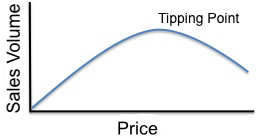
  • Increase the price. You can increase price and often not affect sales volume, but this is tricky because thereis an elusive price Tipping Point. When you cross it your volume will actually decrease because either customers will stop coming or they will buy less. This Tipping Point is unique to every area and every store. One approach is to keep your base price per ounce high but then use discounts and promotions to give customers a lower effective price. Remember that it is much easier to lower your price than it is to raise it.

Lower Costs

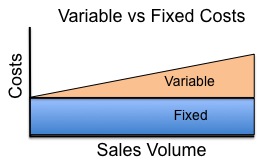
When evaluating costs there are Fixed Costs and Variable Costs. Fixed Costs are costs that are the same regardless of how many customers you serve. For example, your rent cost will be the same whether you serve 10 customers or 300.  Rent is a fixed cost. On the other hand, cups are a variable cost because you only incur costs for each customer.

  • Rent. One of the largest single costs for your store will be rent. There are a couple strategies to take when deciding on a location. For the purposes of simplicity, we’ll break it down into two strategies at opposite ends of the spectrum, even though in reality there are various strategies in between these two.

High Rent/High Volume. If the location is high rent it needs to also be a high traffic area to drive your sales volume. High rent areas may also allow you to charge more per ounce. In order for this strategy to work, you must have a large number of customers.

Low Rent/Low Volume/Low Cost. If the location is a very low rent property that means it’s probably off the beaten path and doesn’t have as much natural traffic. Generally, this would result in less traffic and lower sales volume, although there are stores that are in horrible locations and still gain a “cult following” and have lots of traffic. A low rent location may also mean you need to charge less per ounce, lowering your sales revenue. In order for this strategy to work you have to keep your costs extremely low and find ways to generate traffic in spite of your location.

  • Labor. Labor will most likely be your single highest cost. The big question here is whether or not you can run your store with just one employee. Our profit model shows that unless your store has strong volume (150 customers per day or more), you could lose money having two employees staff your shop. Of Course there are other factors to consider, like employee safety and or employee fraud.
  • Product Costs. this is also a tricky area, because your entire concept is based on your frozen yogurt mix. If you mix isn’t good, you won’t succeed. But at the same time, you shouldn’t throw money away on an overpriced product. Nanci’s solves this issue with mixes that are high-quality, premium mixes, but at a very competitive price.
  • Samples. most likely, the customers will demand free samples, but at the very least you should understand how many free samples you are giving away and how it is affecting your costs. One option is to have the sample cups behind the counter so the customer has to request one from an employee. Studies show that when shoppers make eye contact with a store employee they are less likely to steal something – I’d like to think this principal holds true for abusing the free samples as well.

The general belief in the business world, is that you don’t really make a substantial profit on food retail shops until you own three or more. Depending on your available capital, you may want to consider opening 2 or 3 shops at the same time. This will also give you immediate brand relevance and can often protect your area from incoming competitors.

Don’t forget to check out the profit calculator and feel free to call 1-800-788-0808 or email info@nancis.com with any questions.

Posted on

Increase Sales Part 3: Marketing Tips

Drive Traffic to Your Frozen Yogurt Store with Marketing

“You can have the best product or service in the world, but if people don’t buy – it’s worthless.” Noel Peebles, Marketing Expert


I would add to this quote that if people don’t know about it – it’s worthless.

With the increasing competition in the frozen yogurt industry and stores popping up on every corner, you have to make consumers aware of your shop. Each community is different and some marketing tactics will work in some areas and others will not. The key is to try different things and find what works for you. And remember that what worked yesterday, might not work tomorrow.

The only limit to your marketing is your own creativity. Some ideas can be expensive, but there are plenty that are not.

Here are some ideas we’ve gathered from our customers.

  • Cross marketing with local businesses. Network with gyms and other retails to place coupons or signs in their shop. Host theme nights. Create nights for special interest groups – like book clubs, girls night out, religious study groups, singles groups, etc.
  • School fundraisers with your local elementary school.
  • Coupon mailers.
  • Daily deal websites. Living Social, Groupon, AmazonLocal, or Google Deals.
  • Create a flavor contest. Have people submit their ideas for a flavor via Facebook and in store. Pick three finalists and put their flavors in your machines for one week – with their photo and name above the machine with their flavor. Keep track of how many ounces of each flavor is consumed to determine the winner. This will create a buzz and cause the finalist to get friends and family to come eat their flavor.
  • Group contests. Similar to the Create a Flavor contest above, but have groups compete against each other. This can be especially effective with sororities. The winning can get a donation to the charity of their choice.
  • Street marketing. A sign holder or a person in a frozen yogurt costume can draw attention to your shop.
  • Sponsor or advertise at local races. Just about every community has 5K, 10K, triathlons, and other races throughout the year. There are many options for advertising, including dropping coupons into the bag each racer gets.
  • Social marketing. Leverage Facebook, Instagram, and other social media sites. There are many creative contests and games you can do combine social media with in-store interaction.
  • Online marketing. Create a free Google Places account, as well as other online directory listings. Google AdWords or Facebook advertising can also be effective.
  • Loyalty programs. Tools like Perka can help you put together customer loyalty programs and punch card systems.


We’d love to hear your ideas. Email us at info@nancis.com


Posted on

Increase Sales Part 2: Improve Customer Experience

Improve the In-Store Experience for Your Customers

Kids Activity Area

Most frozen yogurt stores don’t offer a great place for families to relax and enjoy their frozen yogurt. A kids area is a great way to entertain children, so parents can enjoy their time in your shop. Parents will be much more likely to visit your store, if they know their children will be entertained. Even if your shop is small, you can use a corner for some simple kids activities.

A few ideas for a kids area include:
    • Paper and washable crayons/markers
    • TV with kids movies on a loop
    • Small toys or games
    • Simple crafts
    • Video game system – like a Nintendo Wii

Live Music

Ask local musicians to play music on weekends or evenings. Many musicians will play for free or just for tips. If you don’t have room inside your shop, maybe they could set up on your patio and you could put out additional chairs.

Games

Have easy-to-play group games available for customers to use and return. Ideas include trivia games (i.e. Wits & Wagers), Jenga, Catch Phrase, etc.

Do you have other ideas you’d like to share? Email us at info@nancis.com

CLICK HERE TO READ PART 3: MARKETING TIPS


Posted on

Increase Sales Part 1: Expand Menu

Expand Your Menu Beyond Frozen Yogurt

A great way to increase sales, gain new customers, and supplement your frozen yogurt sales is to add new menu items. If you are competing with a large chain, an expanded menu can be extremely effective, because the big chains are restricted on what changes they can make.

There are two different types of menu items you can offer:
  1. Self-service menu items
  2. Full-service menu items.

Self-Service Menu Items

For self-serve frozen yogurt stores, the consistency of the self-serve concept may be very important – both for the customer experience and for in-store operational processes and employees. Here several ideas for self-serve menu items:

  • Belgian waffles. Using a rotating Belgian waffle maker, customers can make their own waffles. This concept is commonly used in hotels and works extremely well. You can charge by the waffle or even by the ounce.
  • Pre-packaged salads
  • Soups
  • Pre-packaged sandwiches
  • Cookies or other pastries
  • Oatmeal
  • Coffee

Full-Service Menu Items

  • Smoothies
  • Sandwiches made to order
  • Full breakfast. Items may include eggs, omelets, breakfast burritos, hash browns, etc.
  • Crepes

Before making any menu changes, you should check your lease agreement to make sure you aren’t prohibited from offering additional food items.

Do you have other ideas you’d like to share? Email them to us at info@nancis.com

CLICK HERE TO READ PART 2: IMPROVE CUSTOMER SERVICE